
16 Jun IN THE NEWS : Fort Lauderdale spends millions wooing developers to invest in Sistrunk. And it’s working.
Sistrunk has long been a boulevard of unrealized dreams. But times are changing. The historic main street that runs through the predominantly Black neighborhood in northwest Fort Lauderdale is no longer a development wasteland, Fort Lauderdale officials say. In the past eight years alone, close to $116 million in city tax dollars has helped lure new development to the Sistrunk corridor west of the railroad tracks, a minority neighborhood that’s long been overlooked. A grand total of $115.7 million has been awarded to developers in forgivable loans, city officials say.
Those financial incentives were a game-changer, said Commissioner Pamela Beasley-Pittman, whose district includes Sistrunk. “It allowed us to utilize property tax funds to remove slums and blight from the area, attracting new investment,” she said. Two major projects currently under construction are expected to make a significant impact on the area, adding 902 apartments to the burgeoning neighborhood along with shops and restaurants.
The Adderley, on the southwest corner of Sistrunk and Northwest Seventh Avenue, features two six-story buildings with more than 400 apartments. Shops and restaurants will line the ground floor. The Arcadian, two eight-story buildings on the northeast corner of Sistrunk and Seventh Avenue, calls for 480 apartments with restaurants and shops on the ground floor. Mount Hermon Apartments has already opened at 750 NW Fourth St. The seven-story building has more than 100 apartments specifically designed to serve low-income seniors.
Buzzing with life
There was a time when Sistrunk was thriving, before a decline came along. Old-timers remember the good old days, when the neighborhood was buzzing with life. Back in the 1960s, the community had its own movie theater, bowling alley, banks, restaurants, law firms and grocery stores. Some still dream of those days returning. Fort Lauderdale has given wings to those dreams in the form of tax dollars aimed at attracting developers to help transform a blighted area into a thriving neighborhood with shops, bars and attractive places to live.
To make that happen, Fort Lauderdale established a Community Redevelopment Agency in 1995 for the Northwest, Progresso Village and Flagler Village (formerly known as Flagler Heights) neighborhoods. The CRA allows the city to take property tax dollars that would normally go to the city, county and other taxing entities and use the money to lure developers with forgivable loans to help revitalize the area.
The strategy worked, city officials say.
Since 2009, the CRA has contributed to the development of more than 3,000 residential units. An additional 1,018 units are currently under construction or anticipated to break ground this year, said city spokeswoman Christine Portela.
The CRA also has awarded incentives to more than 80 commercial properties within its borders, including a mix of small businesses, historic landmarks, schools and community centers, Portela said.
Cut the cord?
The boundaries of the CRA are Sunrise Boulevard to the north, Broward Boulevard to the south, Federal Highway to the east and Northwest 24th Avenue to the west. Sistrunk Boulevard, also known as Northwest Sixth Street, runs through the middle.
Some developers received millions to help bring their projects to life. The developer of the Adderley was given a $12 million forgivable loan from the CRA. The developer of the Arcadian was awarded a $10 million forgivable loan. And the new YMCA building that opened three years ago at 1409 Sistrunk Blvd. was awarded $10 million.
The CRA was scheduled to sunset in November, but city commissioners have agreed to extend the CRA another 10 years in order to help complete a mission that began three decades ago. The county and other taxing entities will not contribute, but an estimated $5 million in Fort Lauderdale tax money — 50% of the full amount previously contributed by the city — will go to the CRA annually. Commissioners agreed to review the plan every two years in case they need to change course due to budget shortfalls.
Commissioner Steve Glassman cast the lone vote objecting to extending the life of the CRA to 2035.
“There is more work to do, but I’m against the extension of the CRA,” Glassman told the Sun Sentinel. “Thirty years is a long time to get your act together. Some of these CRA projects have been approved for 10 years and nothing has happened. We’ve given them the green light and we’ve given them the financing. More than $46 million has been allocated to projects that have not broken ground. I want to be able to cut the cord and repurpose that money and find people who can deliver the project. That’s one reason I think we don’t need to continue the CRA.”
‘Neglected for decades’
Mayor Dean Trantalis defended the decision to keep the CRA going.
“Right now we see a significant amount of redevelopment taking place in the area and much of it as a result of incentives we provided through the CRA fund,” he said. “We felt the momentum needs to be continued in order to continue what I think is an enormous vision of trying to redevelop an area that has been neglected for decades. To stop it in its tracks would be self-defeating. We need to go full circle and complete that goal of developing the area west of the tracks.”
Not every project is a success.
Some never get built. But if they never break ground, they don’t get CRA money.
“If a developer is awarded CRA funding but does not proceed with the project, the funds are not disbursed,” Portela said. “The CRA does not release any funds until the project is actively under construction. Disbursements are typically tied to the developer’s construction draws and are released in coordination with their lender. If the project stalls or is never initiated, the developer receives no CRA funding, and the commitment may be rescinded or expire based on the terms of the funding agreement.”
Many of the projects built along Sistrunk in the past decade would not have seen the light of day without financial help from the CRA, said Robert Lochrie, a prominent land-use attorney in Fort Lauderdale.
“Development is a very difficult business,” Lochrie said. “It involves an entire set of different parameters that come into play to make stuff happen. A lot of people have great ideas, but bringing that to fruition is difficult. It takes money.”
According to the latest update from the city, six projects have been approved and are waiting to break ground. If built, they will add another 421 residential units and 100 hotel rooms to the corridor.Another eight projects are under review, waiting for approval.
One eight-story tower calls for 422 apartments, including 43 affordable units and 1,667 square feet of commercial space. The project, just north of Sistrunk Boulevard and east of Fourth Avenue in Progresso Village, is subject to commission call-up as it makes its way through the review process. The other seven projects would add a total of 449 residential units to the neighborhood.
Priced out?
Not everyone is thrilled with the gentrification of the neighborhood. Some worry it will lead to higher rents and property values, eventually displacing the minority community. Sistrunk, also known as Northwest Sixth Street, was named after the late Dr. James Sistrunk, a pioneering Black physician who helped establish Broward County’s first Black hospital. The corridor is known for its rich African American history.
Some worry that all the changes coming will wipe out that history, said Emmanuel George, community liaison for the Old Dillard Museum. “We’re seeing new faces and new styles and new businesses coming in,” he said. “But can the folks who grew up here afford to live here? It’s not just happening here. The high cost of living is impacting everyone in the United States to some degree. And South Florida has some of the highest costs of living. A lot of people are leaving. And we need to come forward with solutions.”
As prices go up, some people will be forced to move out of the neighborhood, said J.J. Hankerson, president of the Progresso Village Civic Association. “Things are going to get harder to afford,” he said. “And a lot of people will be moving out and other people moving in with all these changes. The buildings are nice, but they’re going to bring a lot of traffic and a lot of people. Good God, you’d think we’re going to be like New York or something. We know things are going to grow, but I hope they don’t overdo it.”
Broward County Commissioner Robert McKinzie, whose district includes the Sistrunk corridor, urges those who own their homes to hold onto them.
“Investors are trying to get people to sell,” he said. “They want these houses. I say, ‘Don’t sell. Stay put.’ The houses here are cheaper than the houses out west or out east. And the property is going to keep growing in value. It’s full of rich Black history.”
‘We need to follow through’
Beasley-Pittman says family members and neighbors have shared stories about the days when Sistrunk was a thriving hub that was the heartbeat of Fort Lauderdale’s Black community.
“This area was more than just a neighborhood,” she said. “It was a city within a city, buzzing with life and filled with pride. We had everything we needed right here. Grocery stores, schools, a movie theater, a bowling alley, churches, dry cleaners, employment services, taxicab companies, banks, restaurants, law firms, photography studios. It was a self-sufficient community where people could get what they needed without having to leave. This area has so much heart and soul, and we must continue to celebrate and honor its legacy.”
Earlier this year, Beasley-Pittman championed the idea of extending the CRA.
“We have projects still on the table,” she said at the time. “We need to follow through.”
The following developments also have received financing from the CRA:
— Six 13, a mixed-use project that opened in 2021 with 142 apartments and 5,991 square feet of restaurant and commercial space at 613 NW Third Ave. CRA contribution: $7 million.
— The Aldridge (1204 Sistrunk Blvd.) and The Laramore (1619 Sistrunk Blvd.), both currently in the permitting process. Two proposed mixed-use affordable housing developments that will each feature 36 apartments in a five-story building that integrates residential living with ground-floor retail spaces and parking garages. Both projects aim to foster vibrant, multi-generational communities while addressing the need for quality, affordable housing. Both will offer affordable rents for at least 30 years to eligible individuals and families earning up to 60% of Broward County’s area median income, with rent capped at 30% of their gross monthly income, including utilities. CRA contribution: $9 million.
— Sistrunk View, a proposed affordable housing project at 790 Sistrunk Blvd. The six-story, mixed-use development will feature between 75 and 106 apartments, with 5,700 square feet of commercial space. The building will consist entirely of affordable housing units, designated for individuals and families with incomes ranging from 30% to 80% of the Area Median Income. CRA contribution: $5 million.
— Seven on Seventh is a mixed-use affordable housing project with 72 apartments, case worker offices and parking facilities at 920 NW Seventh Ave. The affordable housing development has set aside 50% of its units for formerly homeless individuals, many of whom are clients of Broward Partnership for the Homeless, Inc. Rents are targeted to tenants that make between 28% to 60% of the Area Median Income. CRA contribution: $285,000.
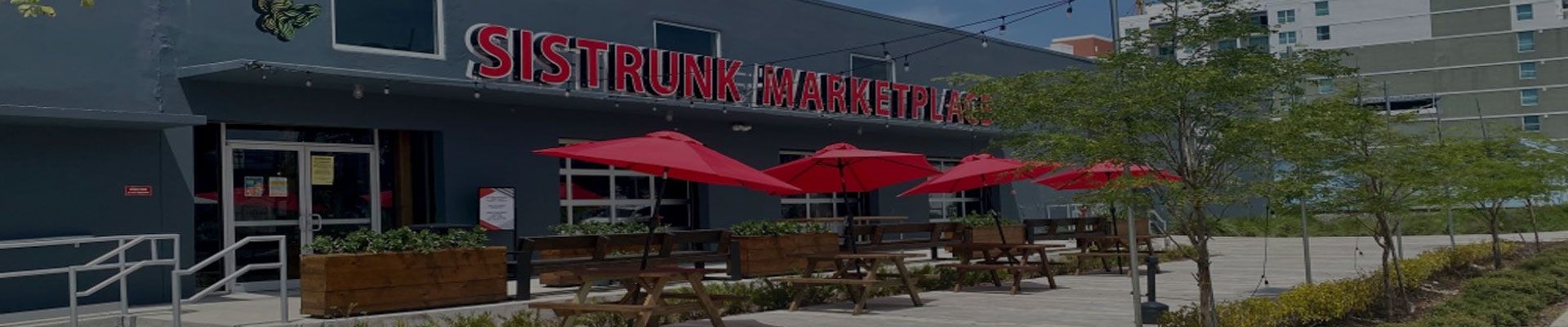
— Sistrunk Marketplace at 115 Sistrunk Blvd. is a former warehouse transformed into a food hall with numerous artisanal food spaces, craft kiosks, gathering spaces, classrooms, event space, seating areas and a fully functioning brewery. Eleven separate unique food vendors and a retail boutique operate out of the facility along with Khoffner Brewery. The space also offers cooking classes, music, art installations and a certified DJ and music production academy. CRA contribution: $1.4 million.
— Smitty’s Wings is located in the center of the historic Sistrunk corridor at 1134 Sistrunk Blvd. The project entailed the gutting of a derelict building for use as a restaurant for people to gather, work, socialize and play — day or night. CRA contribution: $450,000